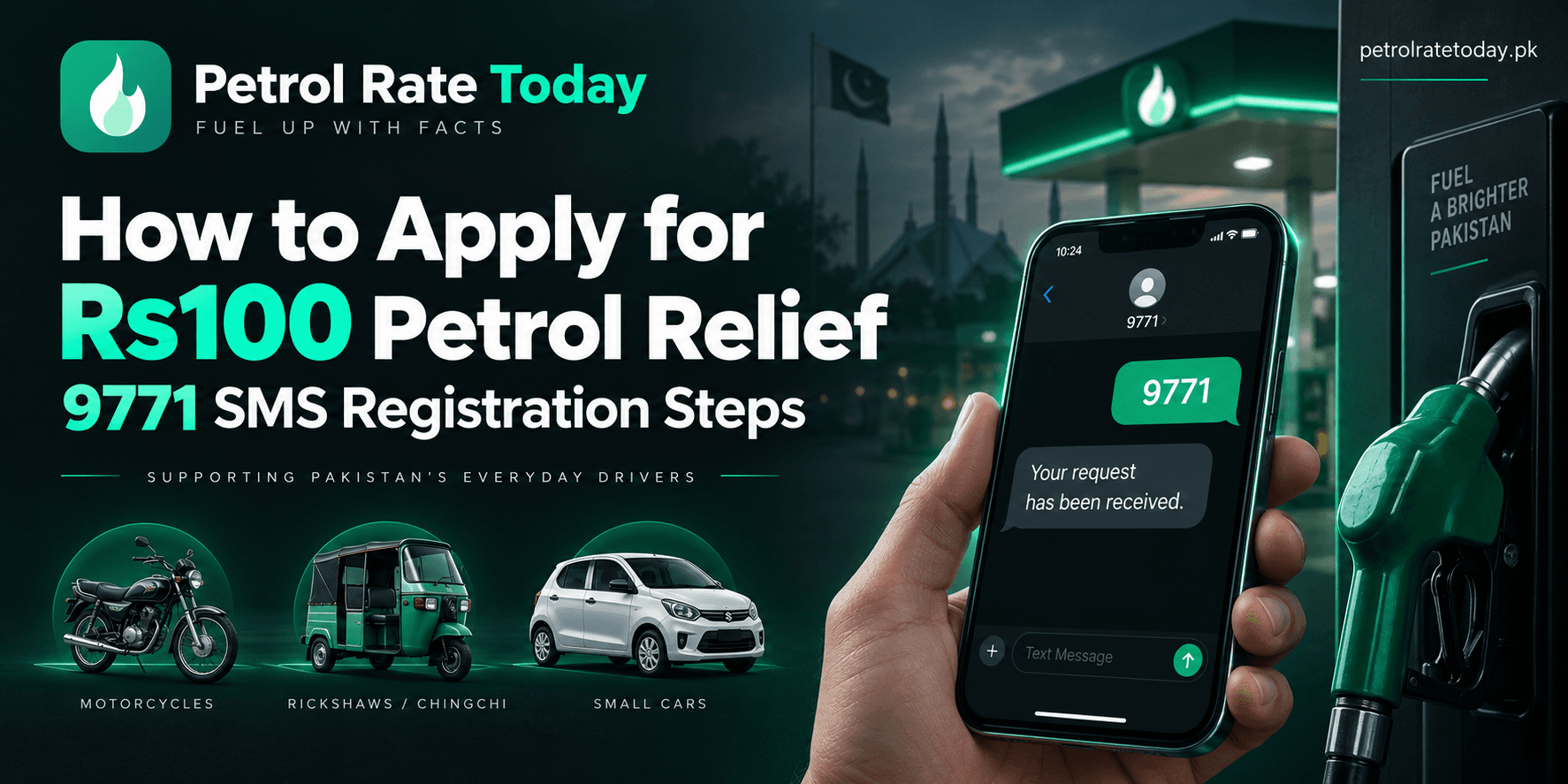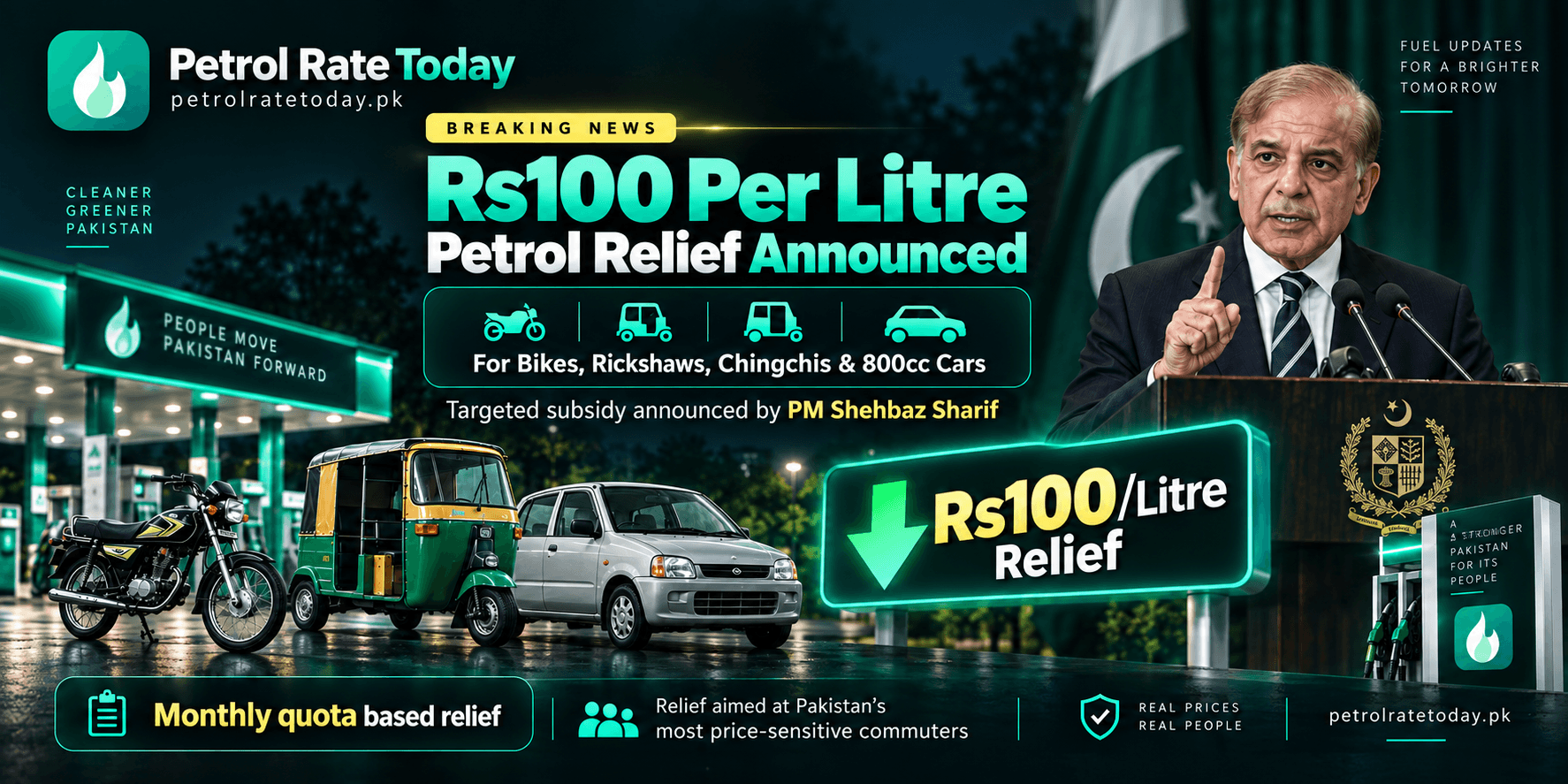
Rs100 Per Litre Petrol Relief Announced for Bikes, Rickshaws and 800cc Cars
PM Shehbaz has announced a Rs100 per litre petrol subsidy for motorcycles, rickshaws and cars up to 800cc. Here are the monthly limits, start dates and what you actually save.
Pakistan's federal government has stepped in after weeks of climbing pump prices. On Sunday, Prime Minister Shehbaz Sharif announced a targeted petrol subsidy that knocks Rs100 off every litre for the country's smallest and most price-sensitive vehicles: motorcycles, rickshaws, Chingchis and cars with engines of 800cc or less.
The relief is capped by a monthly quota rather than being open-ended, so it works less like a price cut and more like a fixed monthly credit for households that feel every rupee at the pump.
What the scheme actually gives you
The subsidy is the same Rs100 per litre for everyone who qualifies. What changes is how many litres it applies to each month.
Anything you buy beyond the quota is billed at the standard retail rate.
| Vehicle category | Relief | Monthly quota | Maximum monthly benefit |
|---|---|---|---|
| Motorcycles, rickshaws, Chingchis and other two- and three-wheelers | Rs100 per litre | 20 litres | Rs2,000 |
| Cars and small vehicles up to 800cc | Rs100 per litre | 30 litres | Rs3,000 |
Start dates: Islamabad first, then the rest of the country
The rollout is staggered by a couple of days.
Registration, however, opened immediately on Sunday. The Prime Minister's Office said the step-by-step process would be explained to the public through an awareness campaign, and the Prime Minister credited the provincial governments for sharing vehicle records for motorcycles, rickshaws and small cars so that eligible owners can be identified without a paperwork scramble.
- Islamabad Capital Territory: the scheme becomes active from the intervening night of Monday and Tuesday, meaning 12am on 15 September 2026.
- Rest of Pakistan, including Azad Jammu and Kashmir and Gilgit-Baltistan: relief begins from the intervening night of Wednesday and Thursday, or 12am on 17 September 2026.
What it means at the pump right now
Petrol currently retails at Rs375.82 per litre after Friday's revision, which added Rs5.02 to the previous rate. High-speed diesel went up by Rs5.28 in the same round and now sells at Rs403.32 per litre. Note that diesel is not part of this scheme.
For a registered motorcycle owner, the effective rate on subsidised litres works out to roughly Rs275.82. Filling the full 20-litre monthly quota costs about Rs5,516 instead of Rs7,516. An 800cc car owner using the entire 30-litre allowance pays around Rs8,275 rather than Rs11,275.
Whether that is meaningful depends heavily on how much you ride. A commuter covering 25 to 30 kilometres a day on a 70cc bike typically burns somewhere close to the 20-litre mark in a month, so the quota lines up reasonably well with everyday usage. For a rickshaw driver running the vehicle all day as a livelihood, 20 litres is a fraction of monthly consumption and the relief functions as partial cushioning rather than a solution.
Why the government moved now
This announcement did not come out of nowhere. Fuel prices have been on a steep and unusually volatile run since the Middle East conflict broke out on 28 February, when strikes on Iran led Tehran to close the Strait of Hormuz, a corridor that previously carried close to a fifth of the world's energy trade.
The numbers since then tell the story:
Pakistan's pricing machinery changed along the way to keep pace. The traditional fortnightly review gave way to weekly revisions after the conflict began, and in July the government moved to a daily review mechanism. Worth remembering: a daily review does not mean a daily change. It simply means the authorities can adjust rates the moment landed costs shift, instead of absorbing the gap for two weeks.
A targeted subsidy of this shape has been tried before. Earlier in 2026, during the first Hormuz-driven spike, the government offered a comparable Rs100 per litre benefit to motorcycle and rickshaw owners with a 20-litre cap. The new version widens the net by bringing 800cc cars into the fold with a slightly larger quota.
- Petrol began March in the region of Rs266 per litre and peaked at Rs458.41 on 3 April.
- High-speed diesel climbed from around Rs281 to a high of Rs520.35 on the same date.
- Prices eased after the June ceasefire between Tehran and Washington, then turned upward again once that arrangement fell apart and attacks on Saudi energy infrastructure added a fresh layer of supply risk.
What is still unclear
A few practical details had not been spelled out at the time of publication:
We will update this page as the registration procedure and operational rules are formally notified.
- The exact registration channel, and whether it runs through an existing digital platform, an SMS-based service or a fresh portal.
- How the quota will be tracked and redeemed at the pump, and what filling stations will need to verify.
- Whether the benefit is tied to the vehicle's registration number or to the owner's CNIC, which matters for anyone whose bike is registered in a family member's name.
- How long the scheme will stay in place if international prices fall back.
- The funding source and its effect on the fiscal side, given that petroleum levy revenue is already a politically sensitive topic.