How to Apply for the Rs100 Petrol Relief: Full 9771 Registration Guide
Step-by-step guide to registering for Pakistan's Rs100 per litre petrol relief scheme. Exact 9771 SMS format, province codes, fuel tokens and common mistakes.
The Rs100 per litre petrol relief announced by Prime Minister Shehbaz Sharif went live at Islamabad pumps from midnight on 15 September, and the rest of the country follows from midnight on 17 September. The subsidy is not automatic. You have to register first, and then request a fuel token every time you want to buy discounted petrol.
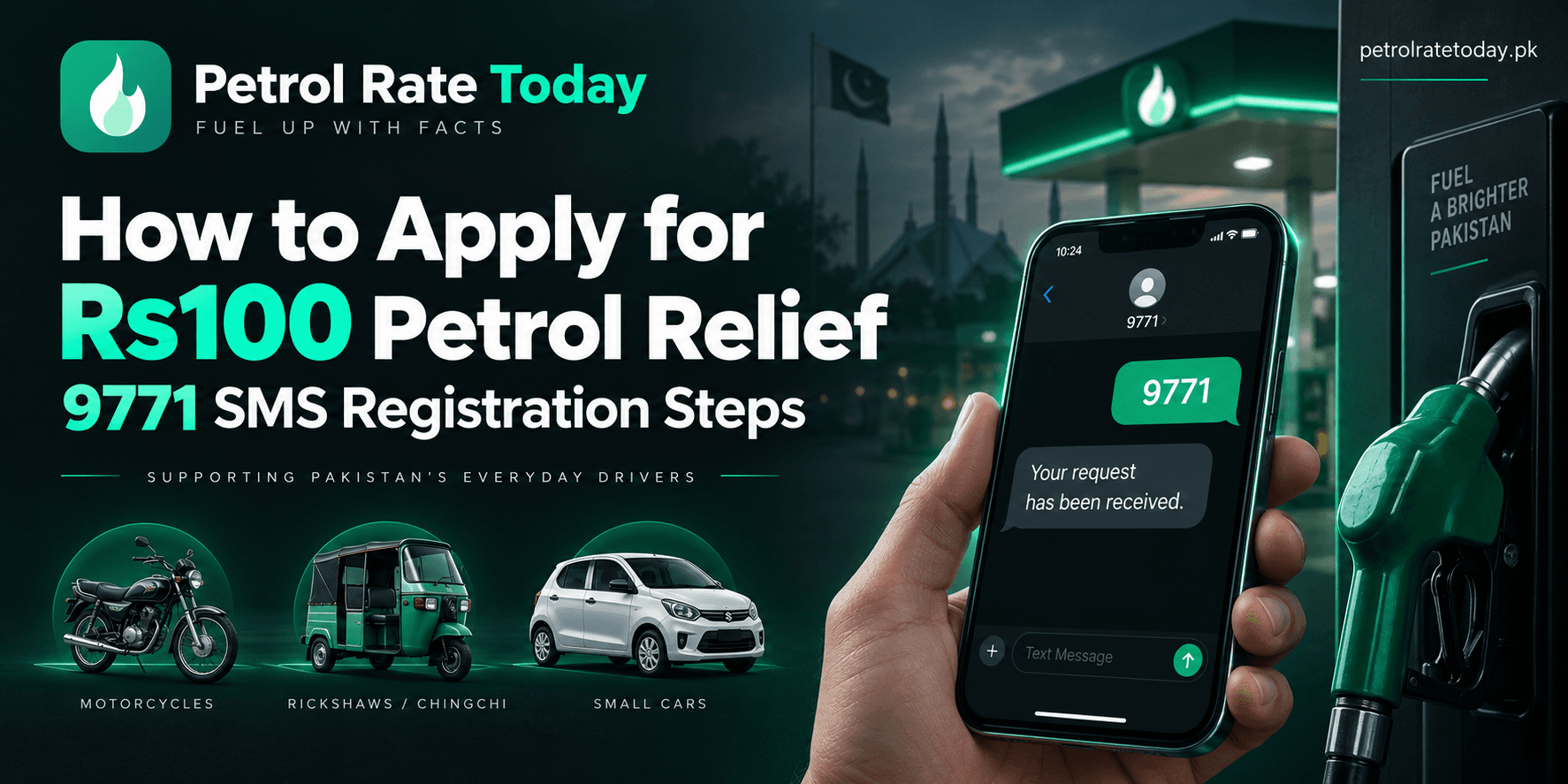
Everything runs over SMS to the short code 9771. There is no app to install, no office to visit and no form to fill. The Ministry of IT and Telecom built the backend with NADRA, the telecom operators and the provincial excise and transport departments, so your identity and your vehicle are both verified against official records before a single rupee of relief is released.
Here is exactly how the process works.
Before you send anything
Three conditions decide whether your message goes through:
If you are not sure which SIMs are registered against your CNIC, sort that out before you send the registration message, because a mismatch is the most common reason for a failed attempt.
- The SIM must belong to you. The mobile number you register from has to be issued against the same CNIC you enter in the message. Your brother's number or a friend's SIM will be rejected.
- Your vehicle registration book must be to hand. You need the registration number exactly as it appears on the book, plus the date the vehicle was registered.
- One CNIC, one vehicle. The system links a single identity card to a single vehicle and a single vehicle to a single identity card. If you own both a bike and an 800cc car, you can register only one of them.
Step 1: Send the registration SMS to 9771
Open your messaging app and type the message in this order, with a single space between each part:
REG <CNIC> <VEHICLE NUMBER> <PROVINCE CODE> <REGISTRATION DATE>
Send it to 9771. Breaking that down:
- REG — type it first, then a space.
- CNIC — all 13 digits, no dashes.
- Vehicle number — as printed on your registration book, with no spaces and no dashes.
- Province code — a single letter for the province or territory where the vehicle is registered (see the table below).
- Registration date — eight digits in DDMMYYYY order. A registration date of 2 September 2026 is typed as 02092026.
Province and territory codes
Use the code for wherever the vehicle was registered, not for where you currently live. A bike registered in Lahore stays a P even if you have moved to Karachi.
Standard SMS charges of Rs1.25 plus tax apply. Registration is a one-time step, so you will not be paying this repeatedly.
| Code | Region |
|---|---|
| P | Punjab |
| S | Sindh |
| K | Khyber Pakhtunkhwa |
| B | Balochistan |
| I | Islamabad Capital Territory |
| A | Azad Jammu and Kashmir |
| G | Gilgit-Baltistan |
Step 2: Wait for the confirmation message
The system runs four automated checks before approving you:
If everything lines up, a confirmation SMS arrives and you are enrolled. No further registration is needed in later months.
- Your CNIC is matched against the SIM you texted from.
- Your vehicle number and province code are checked against provincial excise records.
- Your vehicle registration date is verified.
- The full set of details is cross-checked against government databases.
Step 3: Request a fuel token before every fill
This is the part people miss. Registration alone does not get you cheaper petrol. Each time you plan to buy subsidised fuel, send:
TOK
to 9771 from your registered number. You will receive a digital token by SMS.
The token is issued for a fixed quantity. According to the IT Ministry, a motorcycle user's token covers five litres, which works out to Rs500 off the bill, while a car owner's token covers ten litres, worth Rs1,000 in relief. You cannot request more or less than the fixed amount, and only one token stays active at a time.
Reporting based on the official scheme portal indicates that motorcycles can draw a fresh five-litre token every seven days and cars up to 800cc a fresh ten-litre token every ten days, with unused tokens expiring at the end of that window. These intervals are what keep you inside the monthly ceiling of 20 litres for two- and three-wheelers and 30 litres for 800cc cars. Confirm the current cycle on the official portal before you plan a trip around it.
Step 4: Redeem the token at the pump
Take your phone to a participating petrol station, show the token SMS to the attendant and let them run the verification. Once the token clears, you get your fuel at Rs100 less per litre for the quantity covered by that token. Anything you buy beyond it is billed at the normal pump rate.
One practical note: for cars, the registered owner needs to be present at the pump. That requirement is looser for motorcycles.
Why registrations fail
Most rejections come down to small formatting slips rather than ineligibility:
If your message bounces, check these five things in order before you retry.
- Dashes typed into the CNIC or the vehicle number.
- A space inside the date, or a single-digit day or month without its leading zero. The fifth of March 2019 is 05032019, not 5 3 2019.
- The wrong province code, usually because someone entered where they live instead of where the vehicle is registered.
- Sending from a SIM registered to a family member.
- A vehicle number that does not match the excise record exactly, often after a transfer of ownership that was never updated.
Ignore anyone offering to register you
The IT Minister, Shaza Fatima Khawaja, has been explicit that the government charges nothing for registration and will never ask for extra personal details beyond what goes into the 9771 message. There is no agent, no dealer and no facilitator who can speed up your application or raise your quota.
Treat any of the following as a scam: a call or message asking for an OTP, a request for a registration fee, a WhatsApp link claiming to be the enrolment form, or anyone promising a larger monthly allowance. Do not hand your CNIC number to unofficial websites or individuals.
How big is this scheme
The Petroleum Division estimates the programme will reach roughly 11.8 million users, made up of about 10 million two-wheeler owners, 800,000 three-wheeler owners and around one million small-car owners. Petroleum Minister Ali Pervaiz Malik has put the monthly cost at somewhere between Rs25 billion and Rs30 billion.
For context on what the relief is offsetting: petrol was notified at Rs375.82 per litre after the revision announced on 12 September. Pakistan moved to daily price reviews in July, so check the current rate before you fill up.