How Petrol Price Is Calculated in Pakistan: Full Breakdown
Pakistan's petrol price is built from the international petrol benchmark, the dollar rate, IFEM, OMC and dealer margins, and federal levies. Step-by-step with a full worked calculation.
How Petrol Price Is Calculated in Pakistan
When you look at a petrol pump, you see one price per litre. Behind that number is a chain of international fuel prices, exchange rate adjustments, freight costs, regulated margins and federal levies.
That is why a headline saying crude oil fell 5% does not mean petrol in Pakistan should also fall 5%.
Pakistan's petrol calculation does not begin with Brent crude. It starts with the international market for finished petrol, then works through the import or refinery calculation before freight, business margins and government charges are added.
This guide follows that process step by step, using OGRA's price computation effective 5 September 2026, when the maximum ex-depot price of petrol was Rs345.87 per litre. Every figure below comes from that single notification, so the arithmetic adds up cleanly from the international benchmark to the final number. Components change with each new computation, so for the current rate see our petrol price page.
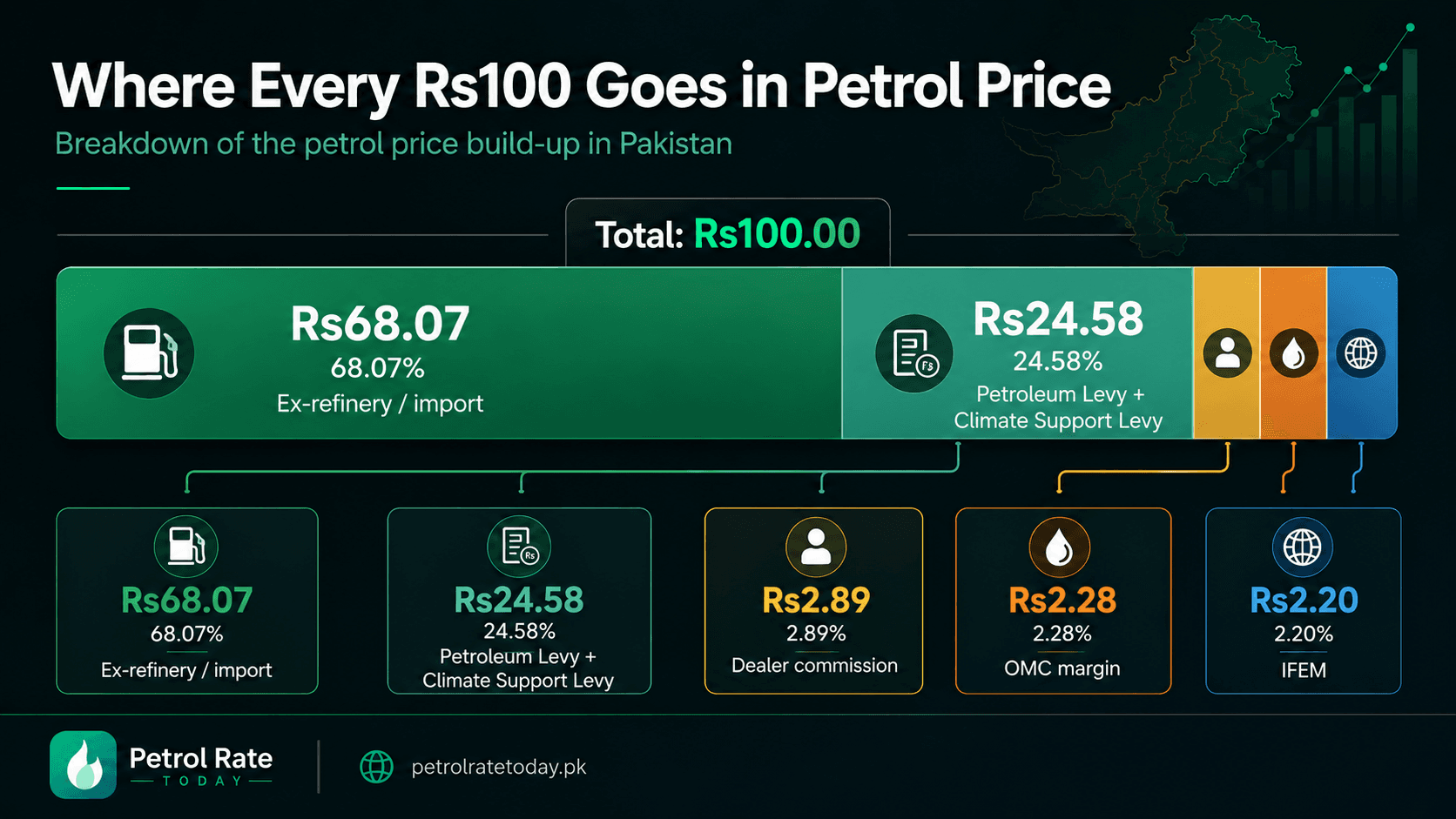
Where every Rs100 goes in the petrol price build-up
Using OGRA's 5 September 2026 build-up, every Rs100 of the Rs345.87 maximum ex-depot price divided approximately like this:
Two things about this table are worth reading carefully.
The ex-refinery/import component is broader than the international price of petrol on its own. It also carries import premiums, incidentals and customs duty.
That means the Rs24.58 covers only the two separately listed levies. It is not the government's total share of the litre, because customs duty is already sitting inside the first line.
Exact figures move with every new computation. The proportions hold reasonably steady, and our live composition table carries the current ones.
| Component | Approx. share of every Rs100 |
|---|---|
| Ex-refinery / import component | Rs68.07 |
| Petroleum Levy + Climate Support Levy | Rs24.58 |
| Dealer commission | Rs2.89 |
| OMC margin | Rs2.28 |
| IFEM | Rs2.20 |
The petrol price formula
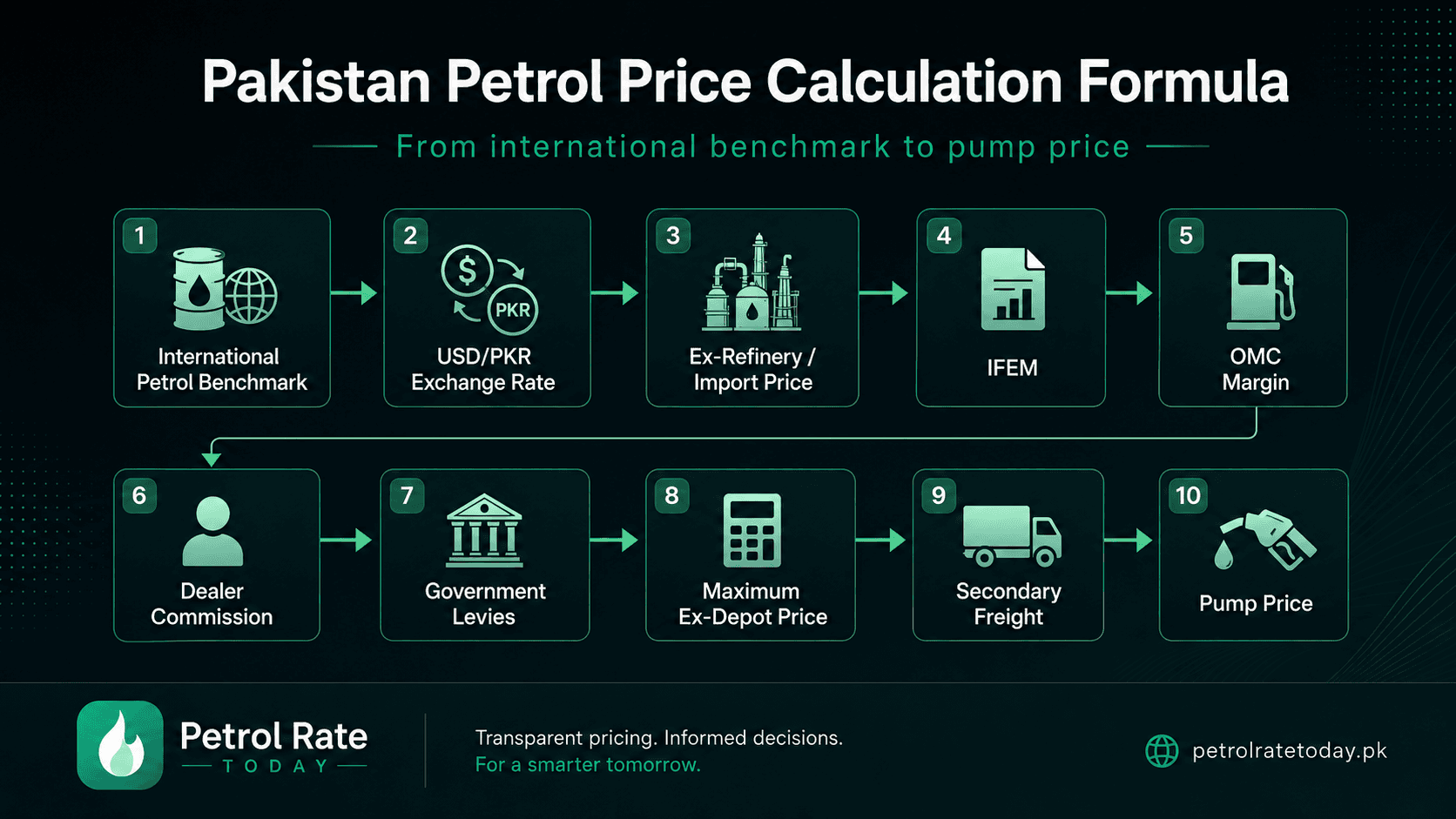
Pakistan's build-up simplifies to:
Ex-refinery/import component + IFEM + OMC margin + dealer commission + Petroleum Levy + Climate Support Levy + sales tax = maximum ex-depot sale price
The words maximum ex-depot sale price matter, because the depot figure is not always the number displayed at every filling station.
A station can carry secondary freight from its supplying depot out to the outlet. This is why OGRA publishes district-wise and pump-wise petroleum price information separately from the national computation.
Step 1: Pakistan uses a finished petrol benchmark
A common mistake is to look at Brent or WTI crude and assume Pakistan's petrol price should move by the same percentage.
The mechanism does not work that way.
Pakistan's calculation is linked to the international price of finished Motor Spirit, not to a crude oil benchmark. Under the current mechanism, that means Platts Arab Gulf assessments for MS 92 RON, averaged across recent working days rather than taken from a single day's trading.
Crude still matters, because it is the raw material refineries start from. But crude and finished petrol trade as separate markets. Refinery outages, regional demand, shipping disruption and shifts in refining margins can all move the petrol benchmark differently from Brent.
So when a headline reports that oil prices fell, the more useful question is whether the finished petrol benchmark fell with it.
Step 2: converting the dollar price into rupees
The international benchmark is quoted in US dollars. Consumers in Pakistan pay in rupees, so the calculation has to convert between the two.
When the rupee weakens, more rupees are needed to cover the same dollar cost, and petrol can become more expensive even though the international price has not moved. A stronger rupee works the other way.
One petroleum barrel contains 158.987 litres.
Using the figures behind this notification:
$111.50 ÷ 158.987 = $0.70132 per litre
At Rs277.61 to the dollar:
$0.70132 × Rs277.61 = Rs194.69 per litre
Step 3: building the ex-refinery / import component
The converted benchmark is not yet the ex-refinery price. Costs involved in bringing the product into Pakistan still have to be added.
The largest of these is the cargo or import premium, the amount a supplier charges above the published benchmark for physical delivery. Smaller incidentals include banking and letter-of-credit charges, insurance, ocean losses, port costs and handling.
Customs duty belongs at this stage. It sits inside the ex-refinery/import component rather than appearing as a separate charge later in the build-up, which is why it should not be counted again further down.
In the 5 September computation, the benchmark converted to Rs194.69 per litre, and the finished ex-refinery/import component came to Rs235.42 per litre. The Rs40.73 gap between the two covers the premium, the incidentals and the customs treatment together.
This is the single largest part of the final price, a little over two thirds of it.
Step 4: freight and the IFEM
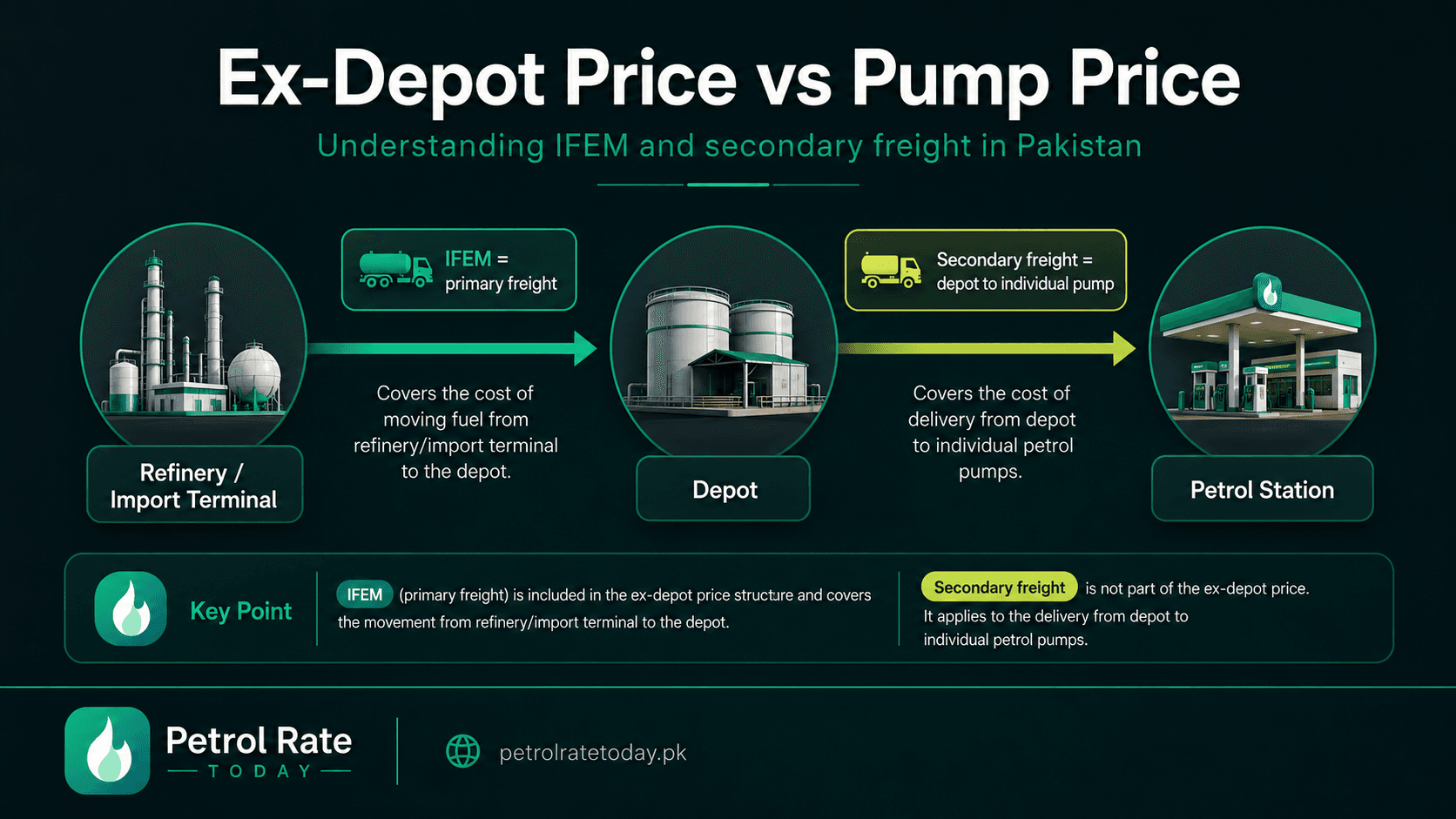
Fuel keeps moving after it leaves a refinery or arrives at an import terminal. Pakistan uses the Inland Freight Equalisation Margin, shortened to IFEM, to pool primary transport costs across the supply system.
Moving a litre from a terminal to a nearby supply location costs less than hauling it a long distance north. IFEM spreads those primary freight costs so that distant supply areas do not carry the full cost of long-haul transport on their own.
In the 5 September build-up, IFEM on petrol was Rs7.60 per litre.
Rs235.42 + Rs7.60 = Rs243.02
IFEM does not mean every station in Pakistan displays an identical retail figure. It deals with movement through the supply system as far as the depot or supply location. The final leg from the supplying depot to an individual filling station is secondary freight, and it can differ by outlet. That is why pump-wise figures on the same effective date are not always identical.
The full chain reads:
International benchmark → ex-refinery/import calculation → maximum ex-depot price → secondary freight → pump price
Hi-Octane works differently again. It is quoted city by city by PSO rather than under a single national figure, which is why Gilgit shows a higher HOBC rate than Punjab. Our Hi-Octane guide explains that difference.
Step 5: the oil marketing company margin
Oil marketing companies run storage, distribution and retail supply. They receive a regulated margin on every litre sold rather than setting their own.
For 5 September 2026 that margin was Rs7.87 per litre.
Rs243.02 + Rs7.87 = Rs250.89
Like the levies further down, this is a fixed rupee amount per litre rather than a percentage of the price. It does not shrink when international prices fall.
Step 6: the dealer commission
The filling station dealer also receives a regulated per-litre commission, covering staff, electricity, equipment, maintenance and day-to-day site operations.
For 5 September 2026 it was Rs9.98 per litre, revised upward from Rs8.64 with effect from 1 September 2026.
Rs250.89 + Rs9.98 = Rs260.87
This is a useful reminder that components in a price build-up belong to a specific notification date. Mixing a margin from one date with a benchmark from another produces a total that matches no actual notification.
Step 7: federal levies
Two federal levies are listed separately in the build-up. Both are charged as fixed rupee amounts per litre rather than as a percentage of the price, which is why they do not shrink when international prices fall.
Petroleum Levy
The largest separately listed government charge. For 5 September 2026 it was Rs80 per litre.
Rs260.87 + Rs80 = Rs340.87
If the international petrol benchmark falls 10%, the Rs80 does not fall by 10% with it. The federal government can revise the rate separately, but international market movement does not change it on its own.
Climate Support Levy
The smaller of the two. For 5 September 2026, Rs5 per litre.
Rs340.87 + Rs5 = Rs345.87
Together the two levies accounted for Rs85 of the litre, close to a quarter of what you paid at the pump.
Step 8: sales tax
No sales tax was added in this calculation.
Petrol and High Speed Diesel are currently exempt from sales tax. The Finance Act 2024 moved these products from zero-rated supplies to exempt supplies.
For the motorist the practical result is the same either way: Rs0 is added to the litre as sales tax. The legal distinction still matters to refineries and oil marketing companies, because exemption and zero-rating treat input sales tax differently.
Rs345.87 + Rs0 = Rs345.87 per litre
That is the maximum ex-depot price.
If you find an article adding 17% GST to a current petrol price, its calculation is out of date.
OGRA and the federal government have different roles
OGRA applies the pricing framework and publishes the resulting petroleum price information. Its notifications and price build-ups are available on the OGRA price publications page.
The federal government controls the policy components OGRA cannot change on its own, including the Petroleum Levy, the Climate Support Levy and the regulated margins. The dealer commission increase to Rs9.98 in September 2026 is an example of a change that came from policy rather than from the market.
So a movement at the pump can originate on either side. International prices and the rupee move the underlying fuel cost. Government decisions move the levies and margins. Sometimes they push in opposite directions, which is why a fall in the international benchmark does not always reach you.
Pakistan moved to a daily pricing framework in July 2026, replacing the weekly system that had itself replaced fortnightly revisions.
A daily framework does not mean the price changes every day. The benchmark is a rolling average across recent working days, and an existing price stays in effect until the next computation is published.
How one litre reaches Rs345.87
Every component in this table comes from the OGRA price computation effective 5 September 2026, published as the source notification. Our methodology page documents how we reconstruct these calculations when new notifications appear.
An individual station's retail price can still reflect secondary freight from its supplying depot.
| Step | Calculation | Running result |
|---|---|---|
| Arab Gulf petrol benchmark | $111.50 / barrel | |
| Convert barrel to litres | ÷ 158.987 | $0.70132 / litre |
| Convert to rupees | × Rs277.61 | Rs194.69 |
| Premium, incidentals and customs treatment | + Rs40.73 | Rs235.42 |
| IFEM | + Rs7.60 | Rs243.02 |
| OMC margin | + Rs7.87 | Rs250.89 |
| Dealer commission | + Rs9.98 | Rs260.87 |
| Petroleum Levy | + Rs80.00 | Rs340.87 |
| Climate Support Levy | + Rs5.00 | Rs345.87 |
| Sales tax | + Rs0.00 | Rs345.87 |
Why a 10% fall in international petrol does not mean 10% cheaper petrol
This is the clearest way to see how the structure works.
Start with the benchmark at $111.50 per barrel and imagine it falls 10%, to about $100.35. Hold everything else steady: the exchange rate, the premium, incidentals, customs, IFEM, both margins and both levies.
The converted fuel component falls by roughly Rs19.47 per litre.
The maximum ex-depot price falls from Rs345.87 to about Rs326.40, a decline of 5.6%.
A 10% fall in the international benchmark produced a 5.6% fall at the depot. Only one part of the total changed. The Rs80 Petroleum Levy did not become Rs72. The Rs5 Climate Support Levy did not become Rs4.50. Freight and both regulated margins stayed where they were.
The same arithmetic works in your favour when international prices rise sharply, since those fixed components do not scale up either.
This is an illustration of the structure rather than a forecast. In practice several components can move at once.
What to check when petrol prices change
Four things explain almost every revision:
- The finished petrol benchmark, not Brent. Crude and petrol can move by different amounts.
- The rupee. A dollar-denominated benchmark can hold steady while its rupee value moves.
- Import-related costs. Cargo premiums, insurance, banking charges, ocean losses, port costs and customs treatment all feed the ex-refinery component.
- Government decisions. Levies and regulated margins do not track international prices automatically, and a change to them can amplify or offset market movement.
The bottom line
Pakistan's petrol price is not the Brent price with a tax percentage added.
It starts with the international market for finished petrol. That dollar benchmark converts into rupees, then absorbs import premiums, incidentals and customs duty to become the ex-refinery/import component. IFEM, the OMC margin, the dealer commission and the federal levies are added on top, producing the maximum ex-depot sale price. Secondary freight can then affect what an individual station displays.
When prices move, the crude oil headline is only part of the answer. The finished petrol benchmark, the rupee, import costs, freight, regulated margins and government levies together explain what is happening at the pump.
Component figures throughout are from the OGRA price computation effective 5 September 2026 and are used as a dated worked example. For the current rate and composition, see our petrol price page.